
Case opening has been part of Counter-Strike since the first weapon case arrived in CS:GO in 2013. Alongside Valve’s own cases there are now dozens of third-party sites that build their own cases from real CS2 skins. Some of them are open about how they work, some are not, and from the front page they look almost identical. Here are seven things worth checking before you put money into any of them.
1. Can you see the odds of every item?
Valve’s cases only come with odds per rarity tier, and even those are known only because they had to be published for the Chinese version of the game: a knife or gloves come out of 0.26% of openings, a blue Mil-Spec skin out of nearly 80%. A case site builds its cases itself, so it has no reason to hide the numbers. A good one shows the chance of each item before you pay, so you can see how much of the probability sits on cheap skins and how much on the ones pictured on the cover.
2. Is the RTP stated?
RTP, or return to player, is the average share of your spending that comes back as items over many openings. At 90%, 100 coins spent return about 90 coins’ worth of skins on average. It says nothing about a single opening, but it is the only fair way to compare sites, and it tells you the real price of the fun: on average, about a tenth of what you spend. If a site gives no figure at all, do not assume it is a generous one.
3. Can you verify a result yourself?
Provably fair means the outcome is fixed before you click and can be recomputed afterwards. The site commits to a secret server seed by showing you its SHA-256 hash, you add a client seed of your own, and every opening gets a number. An HMAC-SHA256 of those values decides the item. When the seed is rotated, the old one is revealed and you can check every opening made with it.
Look for a page where you can paste the seeds in and run the calculation, not just a paragraph saying the site is fair.
4. How are upgrade and contract odds calculated?
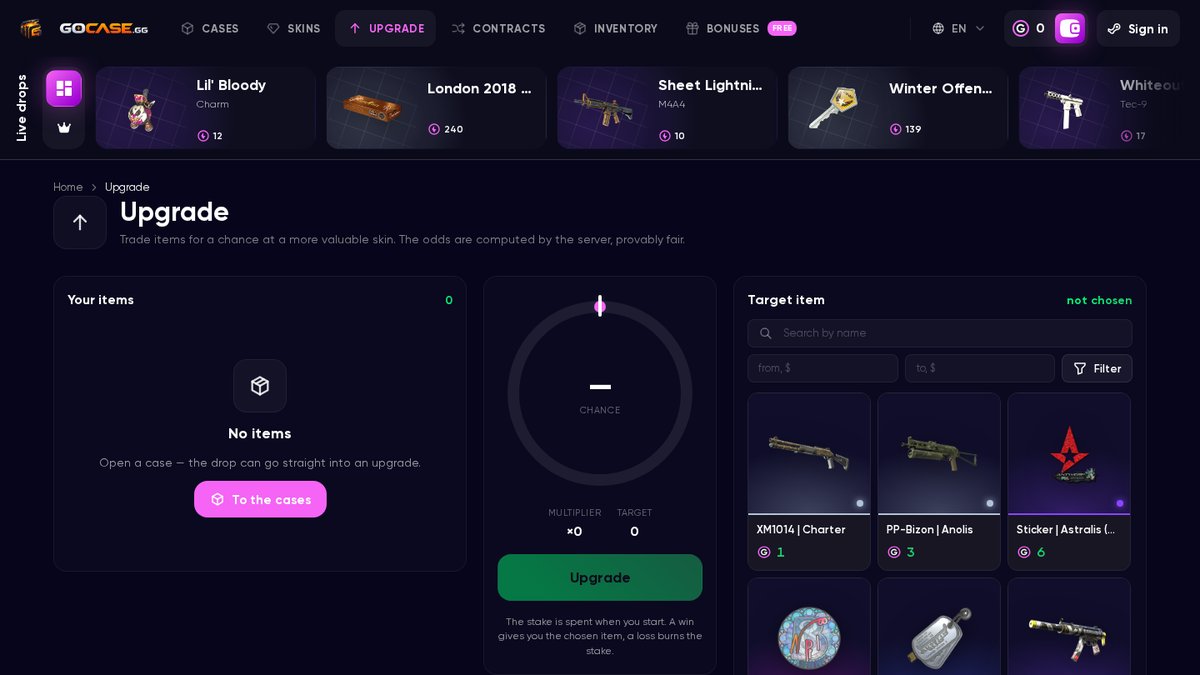
Most sites add an upgrade, where you stake items for a chance at a more expensive one, and a contract, where several items are merged into one. Both should show their numbers before you commit. In a transparent upgrade the chance follows the price ratio. In the CS2 skin upgrade on Gocase.gg, for example, it is the stake divided by the target, times the 90% RTP, capped at 85%: 100 coins aimed at a 300-coin skin gives a 30% chance. A contract should show the value range of the possible result before you sign it.
Remember that a failed upgrade burns the stake, so it is a tool for drops you do not want, not for the best item in your inventory.
5. What happens to your drop?
A skin is only worth something if you can do something with it. Check that items can be withdrawn to Steam through a regular trade offer, and that the sell-back price is clear. Some sites pay well below their own valuation when you sell a drop back to your balance, others pay it in full. That difference changes your real return more than most people expect.
6. How do you sign in?
Sign-in should go through Steam’s own page on steamcommunity.com. A case site never needs your Steam password, your Steam Guard codes or your API key: for withdrawals your trade URL is enough. Any site that asks for more is a reason to close the tab. And check every incoming trade offer in the Steam app before you accept it.
7. Can you try it for free?
A daily free case or a small promo bonus lets you see how a site works, from the opening animation to the inventory and the withdrawal screen, before you deposit anything. It is a cheap way to spot a clunky interface or a sell-back rate you do not like.
What this looks like in practice
As an example, gocase.gg covers all seven points:
- Odds: every case page shows the chance of each item before you open it.
- RTP: the catalogue states a base RTP of 90%.
- Verification: a fairness page recomputes any opening from the seeds, and upgrades and contracts use the same scheme.
- Drops: you can sell them back at 100% of the site’s valuation or withdraw them to Steam.
- Sign-in and free play: sign-in goes through Steam, and there is a free case once a day.
Keep it fun
However transparent a site is, case opening returns less than you put in on average. Treat it as entertainment with a budget you set in advance, do not chase losses, and keep in mind that it is for adults only (18+). For everything else happening in Counter-Strike, from tournaments to updates, follow our CS2 coverage.



Join the discussion